Visualized Engineering





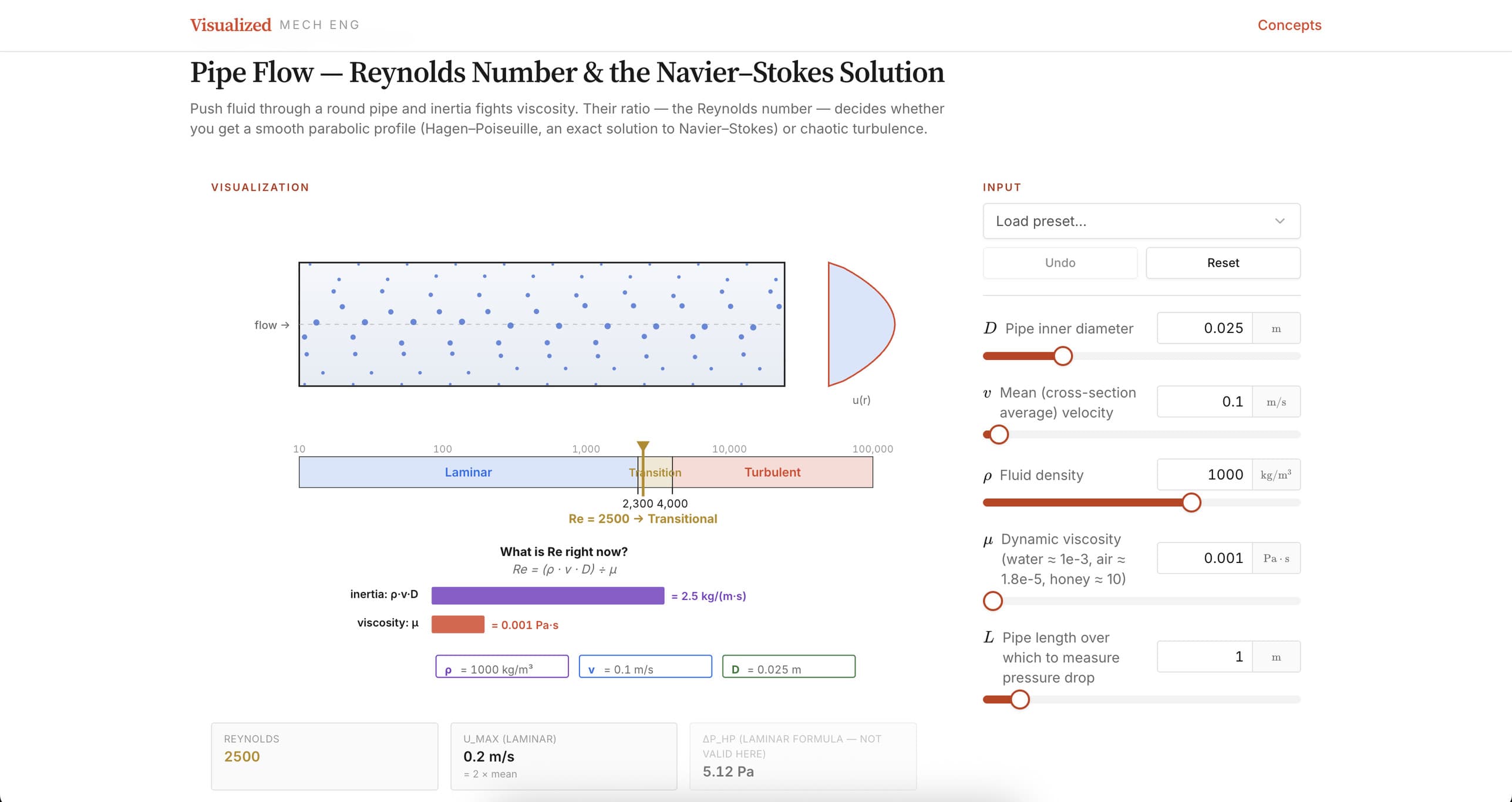
Visualized is a learning tool for mechanical engineering, built around one simple idea: when you can move a slider and watch the diagram and the math react together, hard concepts become obvious. I studied ME before ending up in software — first writing control software for industrial cooling systems, then everything since — and I've always wanted to revisit those ME concepts the way I wish I'd first learned them. The difference between staring at a textbook formula and watching that same formula respond live to my inputs is the difference between memorizing a result and feeling why it's true. Wolfram Alpha was the template.
Architecturally each concept is a folder of four files: a typed schema declaring the parameters, the formula DAG, the references, and the verification cases; an MDX file with the prose; an "intuition" visualization for the primary view; and a more conventional engineering diagram for the secondary view. A registry auto-discovers the folders via import.meta.glob, so adding the next concept is just adding a folder. The framework around them — Pod, ParameterPanel, FormulaTrace, VerificationExample, ReferencesPod — is what gets reused; the visualizations themselves are bespoke per concept because intuition-first visuals don't generalize.
The stack is TanStack Start on Vite, React 19, Tailwind v4, shadcn/ui, MDX for the per-concept narrative, KaTeX for equations rendered server-side and memoized, and mathjs for the formula DAG evaluator. State is per-route React Context + useReducer + useSyncExternalStore so slider drags don't cascade re-renders into siblings — no global state library. URL params are kept in sync via a debounced effect so any scenario you set up is shareable as a link.
Two engineering decisions shaped everything. First, schema-driven concepts. The formula DAG lives in TypeScript, not in MDX or JSX, which means the same source feeds the live "show your work" trace in the UI, the build-time unit reconciliation, and the verification tests. Second, accuracy is non-negotiable. Every formula carries a verified URL citation, every concept ships with at least one worked verification case backed by an expected-value check, and the build refuses to ship if a unit doesn't reconcile. The tool is useless if the numbers are wrong.
Hosted on Vercel at visualized.engineering.